

Safer Internet Day 2026 – Staying Safe Online and Using AI Responsibly
This week we celebrated Safer Internet Day 2026 using resources from the UK Safer Internet Centre. We began with an Internet Safety Assembly, exploring how the internet can be exciting, helpful and creative, but also why we must make safe choices especially as new technologies like AI become more common.
In computing lessons, children learned to:
- Spot online manipulation tactics, such as pressure, flattery, or pretending to be someone else.
- Know what to do if this happens stop, block and speak to a trusted adult.
- Use technology and AI positively, including for learning, creativity and problem‑solving, while understanding the need for adult guidance.
As an additional lesson we looked at using AI Safely and completed activities based on this:
As AI tools appear in games, apps and schoolwork, children were reminded that:
- AI isn’t a person and can sometimes be wrong.
- No personal information (names, photos, passwords, voice recordings) should ever be shared with AI tools.
- New apps, websites or AI tools should always be checked with an adult first.
- AI can help with ideas but shouldn’t replace their own work.
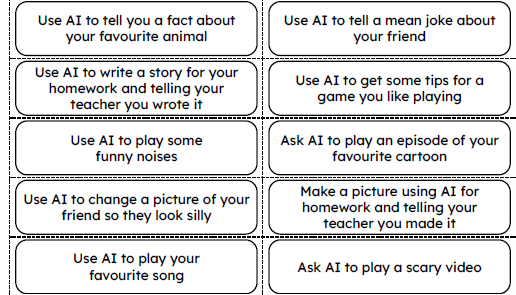
In class, we also looked at different real‑life scenarios showing how technology and AI can be used. The students discussed whether each example was safe and responsible or a misuse. They focused on factors like privacy, fairness, gaining permission, and potential impact.
Y3 then applied this thinking to examples involving AI to decide when AI is being used appropriately and when it isn’t. This helped them meet the learning objectives of recognising responsible technology use and understanding how to use AI safely.
Here are some of the examples we looked at:
Top Tips for Parents and Children (Ages 7–11)
- Stay alert: If something feels wrong or too good to be true, stop and ask an adult.
- Use strong passwords and never share them.
- Think before sharing personal information, even in AI tools.
- Be cautious when chatting or gaming; keep conversations safe and never move chats to private apps.
- Always ask before downloading or buying anything online.
- Remember: it’s never the child’s fault if something goes wrong online.